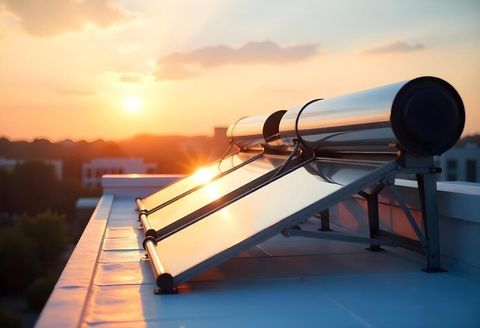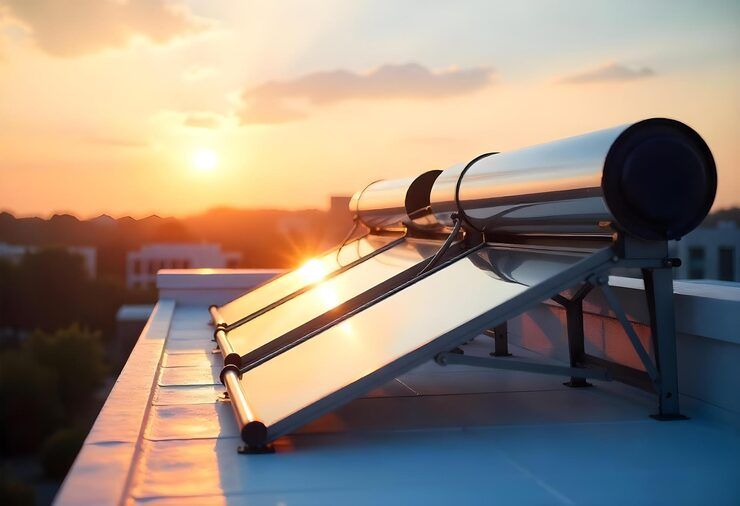
Solar water heater units are systems that use sunlight to heat water for residential, commercial, institutional, and industrial applications. They are part of solar thermal technology, which converts solar radiation into useful heat rather than electricity.
A typical solar water heating system contains a solar collector, water storage tank, circulation arrangement, piping, insulation, controls, and, where necessary, an auxiliary heating system.
The Ministry of New and Renewable Energy (MNRE) describes solar water heating as one of the simplest applications of solar thermal technology. It identifies systems ranging from domestic units to larger installations for hotels, hospitals, restaurants, canteens, and similar facilities.
How Solar Water Heating Works
Solar collectors absorb incoming solar radiation and transfer the resulting heat to water or another heat-transfer fluid.
There are two broad circulation approaches:
Thermosiphon systems: Natural circulation occurs because heated water becomes less dense.
Active systems: Pumps circulate water or heat-transfer fluid through the collectors.
A storage tank retains heated water until it is needed. Insulation around the tank and pipes helps reduce heat loss.
Some installations also use an auxiliary electric or other heating system when solar energy is insufficient.
Main Types of Solar Collectors
Two widely used collector categories are:
Flat-plate collectors: These generally use an absorber plate, transparent cover, insulation, and fluid circulation passages. They are established solar-thermal technology and can be suitable for many domestic and institutional applications.
Evacuated-tube collectors: These use vacuum-insulated tubes to reduce certain forms of heat loss. They are widely used in residential and commercial solar water-heating systems.
| System Type | Main Feature | Common Application |
|---|---|---|
| Flat-plate collector | Large absorber surface | Homes, institutions |
| Evacuated-tube collector | Vacuum-insulated tubes | Homes and commercial buildings |
| Thermosiphon | Natural circulation | Smaller installations |
| Active system | Pump-assisted circulation | Larger or more complex systems |
| Hybrid system | Solar + auxiliary heating | Continuous hot-water requirements |
Why Solar Water Heater Units Matter Today
Hot water can represent a significant portion of energy consumption in homes, hotels, hospitals, educational facilities, and industrial buildings.
Solar water heating can reduce dependence on conventional energy sources for water heating by using available solar radiation. The actual energy contribution depends on local solar conditions, collector orientation, system size, hot-water demand, weather, and auxiliary heating requirements.
Residential Applications
MNRE states that solar water heaters with capacities of approximately 100–500 litres per day (LPD) are suited to domestic applications. Larger systems can be used for facilities such as hotels, hospitals, restaurants, canteens, and guest houses.
Household systems are generally designed around:
Number of occupants
Daily hot-water demand
Local solar radiation
Available roof area
Roof orientation
Shading conditions
Storage capacity
Desired water temperature
Commercial and Institutional Applications
Hotels, hospitals, hostels, restaurants, laundries, and other facilities can have relatively consistent hot-water requirements.
Solar thermal systems can be integrated into larger hot-water networks, sometimes with auxiliary heating for periods when solar output does not meet demand.
Important Design Factors
The performance of a solar water heating system depends on several variables:
Collector type
Collector area
Solar radiation
Orientation and tilt
Shading
Ambient temperature
Water temperature requirements
Storage volume
Pipe insulation
Circulation method
Hot-water consumption pattern
Oversizing a system is not necessarily beneficial. Proper system sizing should reflect actual hot-water demand and local solar conditions.
Recent Solar Water Heating Developments
Solar thermal technology continues to develop through improvements in collectors, materials, system controls, performance testing, and building integration.
Updated Indian Standards During 2025
A significant development occurred in June 2025 when BIS issued implementation guidelines for Amendment No. 2 to IS 16544:2016, covering all-glass evacuated-tube solar water heating systems.
The amendment introduced changes including additional information relating to water-tank capacity and system capacity. BIS stated that implementation was required by September 19, 2025.
This is relevant to manufacturers, testing laboratories, designers, and organizations specifying evacuated-tube solar water heating systems.
Quality Control Framework
India's Ministry of New and Renewable Energy notified the Solar Thermal Systems, Devices and Components (Quality Control) Order, 2024 on October 14, 2024.
The framework covers specified solar thermal components and references relevant Indian Standards. For example, BIS documentation identifies IS 12933 for solar flat-plate collectors and IS 16544 for all-glass evacuated-tube solar water heating systems.
The MNRE quality-control page continues to provide clarifications and related documents for solar thermal systems.
Continued Standardization in 2026
BIS laboratory information shows that IS 16544:2016, IS 16542:2016, and IS 16543:2024 were included within relevant laboratory scopes in June 2026. This supports continued testing and conformity work around evacuated-tube systems and components.
Better Site-Specific Design
Modern solar water heating design increasingly emphasizes local conditions rather than relying on a single standard system configuration.
Factors such as solar radiation, ambient temperature, wind conditions, shading, available roof area, and building height can influence the choice between flat-plate, evacuated-tube, or other collector configurations.
Laws, Standards and Policies in India
India provides an important regulatory example because solar thermal equipment is covered by technical standards and, for specified products, quality-control requirements.
MNRE Framework
MNRE maintains technical information and standards relating to solar water heaters. Its solar water heater resource identifies standards including:
IS 16544:2016: All-glass evacuated-tube solar water heating systems
IS 16543: All-glass evacuated solar collector tubes
IS 12976:2023: Solar water heating systems — Code of Practice
IS 13129 series: Performance, characterization, reliability, and related testing procedures
These standards address areas such as material selection, system design, testing, performance evaluation, durability, and reliability.
Quality-Control Requirements
The Solar Thermal Systems, Devices and Components (Quality Control) Order establishes requirements for specified solar thermal products.
BIS implementation documentation for IS 16544 states that the relevant product manual and licensing scope were revised following the 2024 quality-control order.
Therefore, manufacturers and institutional purchasers should verify the latest MNRE and BIS requirements applicable to the specific system and component.
Building Regulations
Solar water heating can also intersect with building regulations.
BIS's standardized development and building regulations include provisions for solar water heating in certain categories of buildings. The guidance includes considerations such as rooftop sunlight, insulated pipelines, roof load capacity, system capacity, and relevant Indian Standards.
Local building authorities may have additional requirements depending on the building type and location.
Tools and Resources for Solar Water Heater Units
Selecting a solar water heating system requires practical calculations involving hot-water demand, collector area, storage capacity, solar radiation, and auxiliary heating.
Useful Tools
Solar radiation calculators: Help estimate available solar energy at a location.
Hot-water demand calculators: Estimate daily water requirements based on occupancy.
Collector sizing calculators: Help determine approximate collector area.
Storage sizing worksheets: Compare daily demand with storage capacity.
Solar path tools: Help identify seasonal shading and sunlight availability.
Roof-orientation tools: Assist with evaluating collector placement.
Heat-loss calculators: Estimate losses from storage tanks and piping.
Temperature monitoring equipment: Helps assess system operation.
Flow meters: Measure water circulation through the system.
BIS Know Your Standard: Allows users to search Indian Standards by product name or IS number.
MNRE solar water-heating resources: Provide technical information and applicable standards.
Parameters Worth Comparing
When evaluating solar water heater units, useful specifications include:
Daily capacity in LPD
Collector type
Collector area
Storage tank capacity
Tank insulation
Operating temperature
Circulation method
Collector efficiency
Backup heating arrangement
Installation orientation
Roof loading requirements
Pipe insulation
Applicable Indian Standards
Testing and conformity documentation
A larger storage tank does not automatically mean better performance. System capacity should be matched with actual hot-water demand and solar availability.
Frequently Asked Questions
What is a solar water heater unit?
A solar water heater unit is a system that uses solar energy to heat water. It normally includes solar collectors, a storage tank, piping, insulation, and circulation components.
What is the difference between flat-plate and evacuated-tube collectors?
Flat-plate collectors use an insulated absorber assembly, while evacuated-tube collectors use vacuum-insulated tubes. Their performance varies according to climate, system design, operating temperature, installation conditions, and water demand.
How large should a solar water heater be?
Sizing depends on daily hot-water demand, number of users, climate, solar radiation, collector type, storage requirements, and available installation area. MNRE identifies 100–500 LPD systems as suitable for many domestic applications.
Can a solar water heater work during cloudy weather?
Yes, but solar heat collection generally decreases when available solar radiation is lower. Systems intended to provide hot water consistently may therefore incorporate auxiliary heating.
What standards apply to solar water heaters in India?
Relevant Indian Standards include IS 16544 for all-glass evacuated-tube solar water heating systems, IS 16543 for evacuated solar collector tubes, IS 12976 for solar water heating system practice, and the IS 13129 series covering performance and related testing. Applicable quality-control requirements should also be checked through current MNRE and BIS documentation.
Conclusion
Solar water heater units provide a practical application of solar thermal technology by converting sunlight into heat for domestic, commercial, institutional, and selected industrial hot-water requirements.
Their performance depends on more than collector size. Solar radiation, collector technology, roof orientation, shading, storage capacity, water demand, insulation, circulation, and auxiliary heating all influence the overall system.
Developments during 2025 and 2026 demonstrate continued attention to technical standardization in India. BIS introduced implementation guidance for amendments to IS 16544 in 2025, while relevant solar-water-heating standards and laboratory capabilities continued to evolve in 2026.
For anyone researching solar water heating systems, solar hot water systems, solar thermal collectors, or commercial solar water heaters, the most important considerations are system sizing, collector technology, local solar conditions, storage requirements, installation conditions, safety, testing, and applicable standards.
In India, MNRE and BIS provide the principal technical reference points for solar water-heating standards and specified quality-control requirements. Current documentation should be checked before specifying equipment because standards and regulatory requirements can be updated.
As solar thermal technology continues to develop, better system sizing, improved collector materials, stronger testing frameworks, and integration with building-energy planning can help expand the practical role of solar water heating in reducing conventional energy demand.