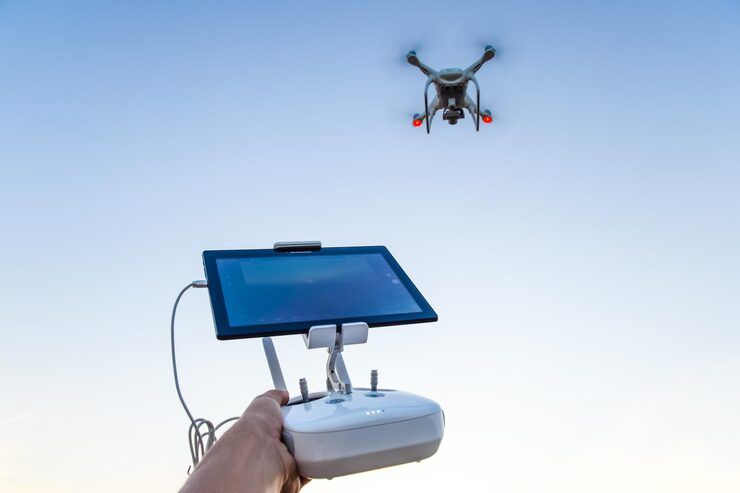
Drone flight controller systems are electronic systems that manage the stability, movement, and navigation of unmanned aerial vehicles (UAVs). They process information from onboard sensors and translate pilot commands or programmed instructions into adjustments that control the aircraft's motors and other flight components.
These systems are essential to modern multirotor drones, fixed-wing UAVs, agricultural aircraft, aerial surveying platforms, and many industrial unmanned aircraft. Without a suitable flight controller, maintaining stable flight and responding accurately to changing conditions would be significantly more difficult.
A flight controller typically combines a processor, sensor inputs, control algorithms, communication interfaces, and software. Depending on the aircraft, it may also connect to satellite navigation, obstacle-detection systems, telemetry equipment, and automated mission-planning tools.
Understanding Drone Flight Controllers
A flight controller acts as the central control system of an unmanned aircraft. It continuously evaluates the aircraft's orientation, movement, and commanded flight behavior.
For example, when a pilot moves a control stick to change direction, the flight controller interprets the input and adjusts motor output to achieve the requested movement. It also compensates for disturbances such as wind and changes in aircraft balance.
Common flight controller components include:
Processor: Executes control algorithms and processes sensor information.
Inertial Measurement Unit (IMU): Measures acceleration and rotational movement.
Gyroscope: Detects angular velocity around the aircraft's axes.
Accelerometer: Measures acceleration and helps estimate orientation.
Barometer: Estimates altitude from atmospheric pressure.
GNSS receiver: Provides satellite-based position and velocity information.
Electronic speed controller interfaces: Communicate motor commands to the propulsion system.
Telemetry interfaces: Exchange flight information with ground equipment.
Not every controller contains every component internally. Some systems use external navigation modules, separate sensors, or additional computers for specialized tasks.
How a Flight Controller Works
A typical flight controller follows a continuous control cycle.
Sensor measurement: The system collects information about orientation, acceleration, altitude, and, when available, geographical position.
State estimation: Software combines sensor readings to estimate the aircraft's current condition.
Command processing: The controller interprets pilot inputs, automated mission instructions, and relevant operating limits.
Control calculation: Algorithms calculate the adjustments required to maintain stability or achieve the requested movement.
Motor output: The controller sends commands to the electronic speed controllers, which regulate motor operation.
Feedback: New sensor measurements allow the controller to evaluate the result and make further corrections.
This cycle occurs repeatedly during flight. Its speed and reliability depend on hardware performance, software design, sensor quality, and the aircraft's configuration.
Main Types of Flight Controller Systems
Different aircraft require different control architectures.
Multirotor controllers: Coordinate multiple motors to control hovering, rotation, and directional movement.
Fixed-wing controllers: Manage aircraft attitude, speed-related controls, and navigation along a flight path.
VTOL controllers: Support aircraft that combine vertical takeoff with forward flight.
Research autopilots: Provide configurable hardware and software for testing control algorithms.
Industrial flight systems: Integrate navigation, telemetry, monitoring, and mission-specific functions.
Selecting a controller requires matching its supported aircraft type, sensor configuration, processing capacity, and software capabilities to the intended application.
Why Drone Flight Controller Systems Matter
Flight controllers affect aircraft stability, operational consistency, navigation accuracy, and the ability to complete planned tasks. Their importance extends from recreational drones to industrial inspection, agriculture, mapping, and scientific research.
Flight Stability and Control
A flight controller helps maintain the aircraft's orientation by continuously adjusting motor outputs or control surfaces. This is particularly important for multirotor aircraft, which rely on coordinated motor thrust to remain airborne.
Wind gusts, changes in payload, and sudden control inputs can disturb an aircraft's balance. A properly configured controller can compensate for many disturbances, although it cannot eliminate every flight risk.
Navigation and Autonomous Flight
When connected to suitable navigation sensors, a flight controller can follow predefined routes, maintain a specified altitude, and execute programmed flight patterns.
Applications include:
Agricultural field mapping
Infrastructure inspections
Land surveying
Environmental monitoring
Industrial site documentation
Search and rescue support
Scientific data collection
Autonomous functions depend on reliable sensors, suitable software, correct configuration, and compliance with applicable aviation rules.
Data Quality and Operational Reliability
For mapping and inspection, consistent aircraft movement can improve the quality of collected data. Unexpected changes in altitude, orientation, or speed may affect image overlap, measurement accuracy, or repeatability.
A flight controller therefore contributes to data collection, but overall accuracy also depends on cameras, positioning systems, calibration, flight planning, and environmental conditions.
Recent Developments in Drone Flight Controller Technology
Developments during 2025 and 2026 have emphasized open-source autopilot software, onboard computing, sensor integration, and more structured approaches to autonomous aircraft operations.
Advances in Open-Source Autopilot Systems
Open-source platforms such as PX4 and ArduPilot continue to support research, education, and commercial UAV development. Their software ecosystems provide configurable flight modes, navigation functions, telemetry interfaces, and integration with supported hardware.
Recent development activity has continued to focus on reliability, hardware compatibility, navigation improvements, and testing tools. Because releases and supported features change frequently, developers should consult the current documentation for the specific software version and controller hardware.
Artificial Intelligence and Onboard Computing
Drone systems increasingly combine conventional flight control with separate onboard computers that process camera images, mapping data, or other sensor information.
This architecture allows the flight controller to manage fundamental flight stability while a companion computer performs computationally demanding tasks. Examples include visual inspection, object recognition, and environmental analysis.
However, artificial intelligence does not automatically make an aircraft safer or fully autonomous. Performance depends on sensor quality, software validation, computing limitations, and how the system responds when information is incomplete.
Navigation Resilience
Satellite navigation can be affected by buildings, terrain, interference, or signal obstruction. As a result, drone developers continue to examine ways to combine GNSS with inertial sensors, cameras, and other positioning methods.
Sensor fusion can improve the continuity of navigation estimates, but alternative positioning methods also have limitations. System designers need to evaluate expected operating environments and test how the aircraft behaves when a sensor becomes unavailable.
Laws, Policies, and Aviation Safety
Drone flight controller systems operate within a wider aviation framework. Regulations generally address aircraft registration, pilot qualifications, operating limits, airspace access, and requirements for particular types of flight.
The applicable rules depend on the country, aircraft category, aircraft weight, and intended operation.
Drone Regulations in India
India's Drone Rules, 2021, establish a regulatory framework for unmanned aircraft systems. The rules address areas including aircraft classification, registration requirements, pilot certification where applicable, and operational conditions.
The Directorate General of Civil Aviation (DGCA) administers relevant aviation requirements, while the Digital Sky platform supports designated digital processes related to drone operations.
Operators should verify current requirements before flying because permissions, aircraft categories, and operating conditions may differ depending on the operation and location.
Regulations in the United States
In the United States, the Federal Aviation Administration (FAA) regulates civil drone operations.
Requirements vary according to the operation. For example, commercial operations conducted under Part 107 generally involve remote pilot certification, applicable registration requirements, and compliance with airspace and operating restrictions.
Automated flight does not remove the operator's responsibility to comply with applicable aviation regulations.
Safety and Software Configuration
Flight controller configuration is also an important safety consideration. Incorrect sensor orientation, unsuitable control parameters, faulty wiring, or inappropriate failsafe settings can lead to unstable behavior.
Before flight, operators should verify:
Correct aircraft configuration
Sensor calibration
Motor and propeller condition
Battery status
Control response
Navigation signal quality
Return-to-home settings, where applicable
Loss-of-communication behavior
Applicable airspace restrictions
Testing should begin in a controlled environment appropriate to the aircraft and the operator's experience.
Tools and Resources for Flight Controller Systems
Several software platforms and technical resources support flight controller selection, configuration, simulation, and maintenance.
PX4 Autopilot
PX4 is an open-source flight control platform used in research, development, and supported commercial UAV applications. Its ecosystem includes configuration tools, simulation options, and documentation for supported aircraft and hardware.
ArduPilot
ArduPilot supports multiple vehicle types, including multirotors, fixed-wing aircraft, and rovers. Its configuration tools allow users to examine sensor data, set flight modes, review logs, and configure supported features.
Ground Control Software
Ground control applications help users configure flight parameters, monitor telemetry, plan missions, and review flight status.
The specific application depends on the autopilot platform and hardware compatibility. Users should follow the recommended setup process for their selected system.
Simulation and Testing
Software-in-the-loop and hardware-in-the-loop simulation can help evaluate control behavior before a real flight.
These approaches allow developers to test mission logic, navigation responses, and selected failure conditions in a controlled environment. Simulation does not replace physical inspection or carefully managed flight testing.
Useful Technical Measurements
Measurement | Purpose |
|---|---|
IMU data | Estimates movement and orientation |
GNSS position | Supports geographical navigation |
Altitude estimate | Helps maintain vertical position |
Battery voltage | Monitors electrical power status |
Motor output | Indicates commanded propulsion response |
Vibration levels | Helps identify mechanical or sensor problems |
Flight logs | Supports troubleshooting and performance analysis |
Recorded measurements can help identify problems that may not be obvious during flight. Interpretation requires an understanding of the aircraft configuration and the limitations of each sensor.
Frequently Asked Questions
What does a drone flight controller do?
It processes sensor measurements and pilot or mission commands to maintain aircraft stability and control movement. Depending on the system, it can also support navigation, automated flight modes, and failsafe responses.
What is the difference between a flight controller and an autopilot?
A flight controller manages aircraft stabilization and control. An autopilot generally refers to a broader system that includes flight control and additional functions such as navigation, mission execution, and automated responses. The terms can overlap depending on the platform.
Which sensors are commonly used in drone flight controllers?
Common sensors include gyroscopes, accelerometers, barometers, and GNSS receivers. Some systems also use magnetometers, optical-flow sensors, cameras, or external positioning equipment.
Can a flight controller make a drone fully autonomous?
A flight controller can support autonomous functions, but complete autonomy depends on additional hardware, software, navigation systems, and operational safeguards. The aircraft must also comply with applicable aviation regulations.
How often should a flight controller be checked?
The controller should be inspected according to the manufacturer's guidance and the aircraft's maintenance schedule. Checks are particularly important after repairs, firmware changes, hard landings, sensor replacement, or unexplained flight behavior.
Conclusion
Drone flight controller systems are central to modern unmanned aircraft because they combine sensor information, control algorithms, and motor commands to support stable and predictable flight.
Their capabilities extend from basic stabilization to navigation, automated mission execution, and integration with advanced onboard computing. Recent developments in open-source autopilots, sensor fusion, and artificial intelligence continue to expand the range of applications for UAV technology.
Reliable operation still depends on correct configuration, suitable hardware, testing, maintenance, and compliance with aviation regulations. Understanding these factors helps operators and developers evaluate flight controller systems more effectively and use drone technology responsibly.